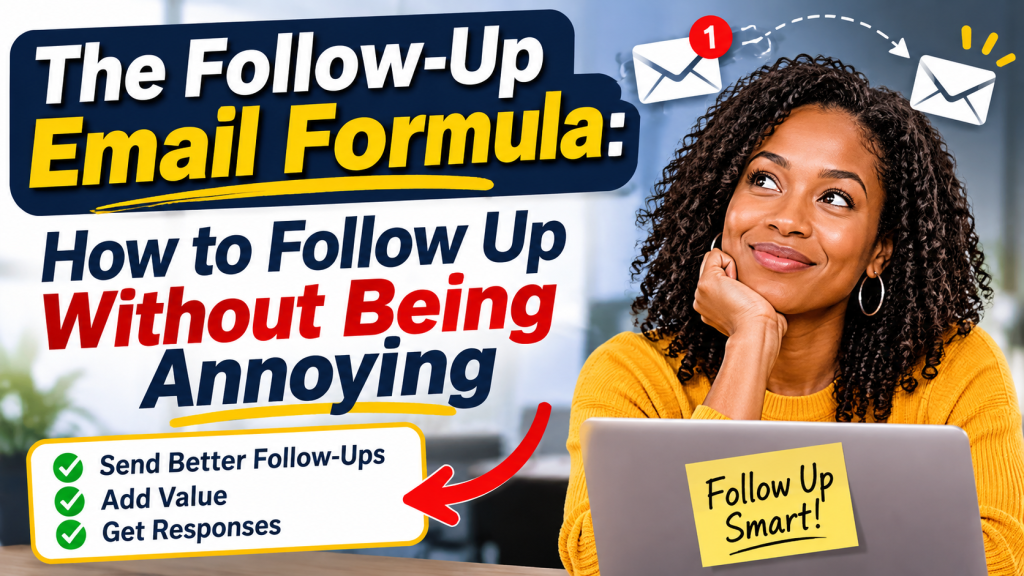
The Follow-Up Email Formula: How to Follow Up Without Being Annoying
You’ve sent the email. You’ve waited a day or two. You check your inbox, hoping for a response.
Nothing.
So what do you do?
Do you send another email? Wait another week? Give up and move on?
Here’s the truth: Most business opportunities aren’t lost because someone said no. They’re lost because the conversation never continued.
Following up is one of the most important skills in email marketing, sales, networking, and business development. Yet many people get it wrong. They either follow up too aggressively, send messages that add no value, or disappear after one unanswered email.
The secret isn’t sending more emails. It’s sending better follow-up emails.
Let’s break down a simple formula you can use to follow up professionally without sounding desperate, pushy, or annoying.
 Why Following Up Matters
People are busy. Their inboxes are crowded. Your email might have arrived at the wrong time, gotten buried under dozens of other messages, or simply slipped their mind.
No response doesn’t automatically mean rejection.
A well-written follow-up can bring your message back to someone’s attention and give them another opportunity to respond.
For businesses, this can mean:
- Reconnecting with potential customers.
- Turning interested prospects into paying clients.
- Starting conversations with potential partners.
- Getting responses from podcast hosts, media contacts, and collaborators.
- Building relationships that could lead to future opportunities.
But there’s a difference between being persistent and becoming a nuisance.
That difference comes down to your approach.
The Follow-Up Email Formula
Here’s a simple five-part formula you can use when someone hasn’t responded to your original email.
1. Start With a Friendly Reminder
Don’t open with an accusation or make someone feel guilty for not responding.
Avoid phrases like:
“Why haven’t you responded to my email?”
Instead, use something natural and professional:
“Hi Sarah, I wanted to follow up on my previous email in case it got buried in your inbox.”
This acknowledges that people are busy without making them feel pressured.
2. Remind Them Why You’re Reaching Out
Don’t assume the recipient remembers your original message.
Briefly explain what you contacted them about.
For example:
“I originally reached out to discuss a possible partnership between our businesses and how we might be able to create value for both audiences.”
Keep this section short. You’re reminding them, not repeating your entire sales pitch.
3. Add Something Valuable
This is where most follow-up emails fail.
A weak follow-up simply says:
“Just checking in to see if you received my last email.”
That doesn’t give the recipient a compelling reason to respond.
Instead, add something useful:
- A helpful resource.
- A new idea.
- A relevant article.
- A potential solution to a problem.
- A fresh opportunity.
- A brief explanation of how working together could benefit them.
For example:
“I also came across an idea that I think could make this collaboration especially valuable for both of our audiences.”
Now you’re giving the recipient something new to consider.
Remember: Every follow-up should have a purpose beyond asking for a response.
4. Make It Easy to Respond
Don’t make people work hard to answer your email.
Avoid asking five different questions or requesting a lengthy explanation.
Give them one simple next step.
Examples:
“Would you be open to a quick 15-minute conversation next week?”
“Would you be interested in exploring this opportunity?”
“Is this something you’d like me to send more information about?”
The easier you make it to respond, the less friction you create.
5. Close Without Pressure
Your closing should leave the door open without making the recipient feel obligated.
Try:
“No pressure if the timing isn’t right. I appreciate you taking a moment to consider it.”
Or:
“If this isn’t a fit right now, I completely understand. I’d be happy to reconnect at another time.”
Professional follow-up is about keeping the relationship positive, even when the answer is no.
How Long Should You Wait Before Following Up?
Timing matters. Follow up too quickly and you risk appearing impatient. Wait too long and the conversation may lose momentum.
Here’s a practical schedule for ordinary business outreach:
| Follow-up | Suggested timing | Purpose |
|---|---|---|
| First follow-up | 3–4 business days | Friendly reminder |
| Second follow-up | 5–7 business days later | Add value or a new angle |
| Final follow-up | 7–10 business days later | Politely close the loop |
These are general guidelines, not universal rules. Adjust them based on the relationship, industry, urgency, and the recipient’s preferences.
If someone asks you not to contact them again, respect that request immediately. If they decline, don’t keep pursuing the same opportunity.
Three Follow-Up Email Examples You Can Use Today
Here are three practical templates for different business situations.
Example 1: Following Up With a Potential Customer
Subject: Following Up on My Previous Email
Hi [First Name],
I wanted to follow up on my previous email in case it got buried in your inbox.
I reached out because I believe [product/service] could help you with [specific benefit or problem].
I’d be happy to share a few more details or answer any questions you might have.
Would you be open to a quick conversation?
Best,
[Your Name]
Example 2: Following Up With a Podcast Host
Subject: Following Up on My Guest Invitation
Hi [First Name],
I wanted to circle back on my invitation to be a guest on your podcast.
I believe we could have a great conversation about [relevant topic], and I think your audience would find the discussion valuable.
I’d be happy to work around your recording schedule if you’re interested.
Would you be open to discussing it?
Best,
[Your Name]
Example 3: The Final Follow-Up
Subject: Should I Close the Loop?
Hi [First Name],
I wanted to send one final follow-up regarding my previous message.
I understand you’re busy, and I don’t want to clutter your inbox.
If this isn’t a good fit or the timing isn’t right, no worries at all. If you’d like to revisit the conversation in the future, I’d be happy to reconnect.
Thanks for your time!
Regards,
[Your Name]
Seven Follow-Up Mistakes That Make You Look Annoying
Even a good opportunity can be damaged by poor follow-up habits.
Here are seven mistakes to avoid:
1. Following up every single day. Give people reasonable time to respond. Constant reminders create unnecessary pressure.
2. Sending the exact same email repeatedly. If your first message didn’t get a response, repeating it word for word probably won’t help.
3. Using guilt or pressure. Statements like “I guess you’re not interested” can damage a relationship before it even starts.
4. Writing long follow-up emails. Keep your message focused. Most people appreciate communication that respects their time.
5. Making every follow-up about yourself. Focus on the recipient’s needs, interests, and potential benefits.
6. Ignoring previous responses. If someone has already declined or requested no further contact, respect their decision.
7. Never knowing when to stop. A professional follow-up sequence should have a reasonable ending. Sometimes silence means it’s time to move on.
How AI Can Make Your Follow-Up Emails Smarter
Writing effective follow-up emails takes time, especially when you’re contacting dozens or hundreds of potential customers, partners, or business prospects.
This is where AI can help.
Instead of writing every message from scratch, AI can help you:
- Create personalized follow-up messages.
- Adjust your tone to sound more professional, friendly, or conversational.
- Generate different subject line ideas.
- Rewrite repetitive emails so they don’t all sound identical.
- Evaluate email quality before sending.
- Develop follow-up sequences for different types of prospects.
But remember: AI should help you communicate better, not turn your outreach into a flood of generic automated messages.
The goal is to make every email feel relevant and worth reading.
That’s one reason tools like SendEmailsRight can be useful. Its AI-powered approach is designed to help you create more personalized emails that better reflect your writing style and evaluate your messages before sending.
Explore it here: https://sendemailsright.com
The Bottom Line: Follow Up With Purpose, Not Pressure
Following up isn’t annoying. Sending meaningless messages over and over again is.
The best follow-up emails are short, relevant, personalized, and respectful. They remind people why you reached out, offer something useful, and make it easy to respond.
Don’t just ask, “Did you see my last email?”
Give people a reason to continue the conversation.
Because in business, the fortune isn’t always in the first email. Sometimes it’s in the thoughtful follow-up that keeps the opportunity alive.
Stop chasing responses. Start creating conversations.
Want to write smarter emails, improve your outreach, and make your messages sound more like you? Discover a smarter approach to email writing and outreach at SendEmailsRight.com.
#EmailMarketing #EmailOutreach #FollowUpEmails #AIEmailWriting #LeadGeneration #SalesTips #BusinessGrowth #EmailMarketingStrategy